Love Overflow: When Trauma Makes Us Love Too Much, Too Fast
There’s a lot of talk around ‘love bombing’ these days — about how it’s a manipulation tactic used by narcissists to hook someone emotionally and then control them. But what happens when what looks like love bombing… isn’t manipulation at all, but a trauma response?
For a long time, I carried this pattern of loving too quickly and giving too much — too soon. Not because I was toxic. Not because I wanted to control anyone. But because I was finally seen. And being seen felt like water to someone who’d been emotionally thirsty for years.
I have always been a servant at heart. I know what it feels like to be helpless. I know what it’s like to carry the silence of trauma — from being inappropriately touched as a little girl and not knowing who to tell, to being coerced in the military even when I said no. I did what I thought was best — pretending like it didn’t happen because I didn’t know what to do. I was scared. I didn’t have a voice then. But I do now.
Now I know that when I overshare, overthink, overanalyze, and over-love — it’s my trauma trying to protect me from abandonment. It’s the little girl in me saying, ‘Maybe if I love hard enough, this time someone will stay.’
I used to fight with myself. Wanting love but fearing it. Dreaming of marriage, but believing I’d never be worthy of it. I never had a healthy model of what love looks like. My family dynamics were broken. My trust was fractured. But my hope? It never fully left.
Today, I’m coming from a healed place. My recent trip to Peru helped release the childhood trauma I no longer carry. The little girl inside is finally at peace.
When I love, I love hard. However, I do recognize that this is a trauma response. So, I no longer call it love bombing. I call it **love overflow** — because my heart is big, and I’ve lived through a lot, and I still believe in love. But now, I’m learning to give love without abandoning myself in the process.
I’m learning how to set boundaries.
I’m learning how to recognize when someone hasn’t earned the deepest parts of me yet.
And most importantly, I’m learning that I am not too much. I was just unprotected.
That’s why I created the ‘Safe-to-Share Scale.’ It’s a simple guide that helps me pace emotional sharing. It protects my softness without hardening my heart.
Because the right person won’t need the flood. They’ll respect the flow. They’ll earn it, step by step.
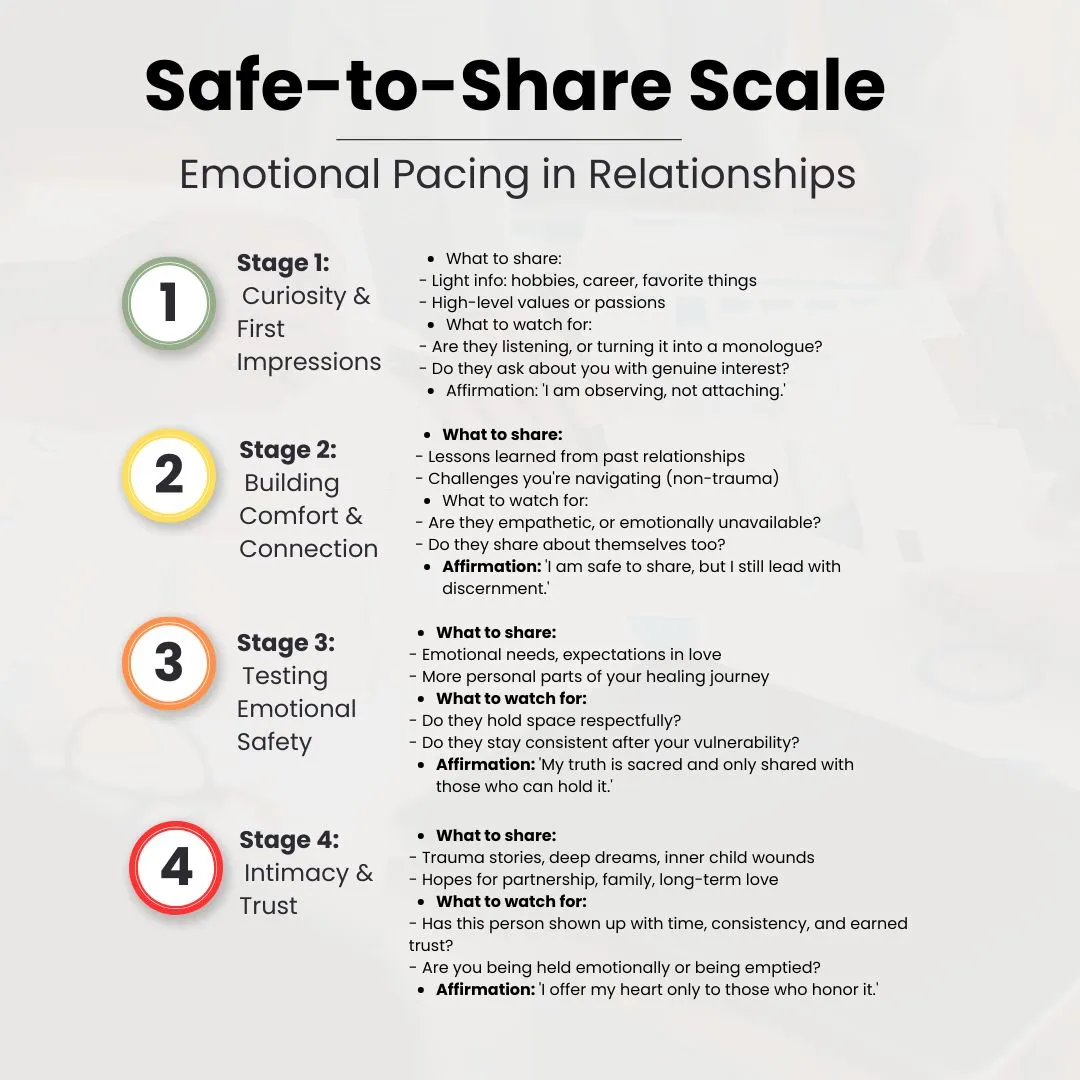 Safe-to-Share Scale
Healing doesn’t mean you won’t have these moments. It means you recognize them sooner — and choose differently next time. This is where emotional intelligence comes in.
Self-awareness around the tendency to “over-love” is one of the highest expressions of emotional intelligence — especially when it’s paired with reflection, compassion, and intentional growth.

The Role of Emotional Intelligence in Love Overflow
Recognizing when we over-love or give too much too fast is not a flaw — it’s a sign of emotional intelligence. Emotional intelligence is our ability to notice, understand, and regulate our emotions, especially in relationships.
You are emotionally intelligent when you:
• Recognize emotional patterns and pause to reflect
• Understand how trauma shaped your relationship responses
• Set boundaries not to punish, but to protect your peace
• Express love intentionally, without abandoning yourself
Owning your patterns — without shame — and choosing to do the inner work is one of the most powerful acts of self-leadership. It shows that you value both your heart and your healing.
You’re not too much. You’re emotionally aware.
You’re not dramatic. You’re discerning.
And you’re not broken — you’re evolving.
Let your self-awareness be your strength. It’s not weakness to love — it’s wisdom to pace it with care.
Remember the term“love bombing” that I mentioned earlier? In mainstream circles often refers to a manipulative tactic rooted in narcissistic abuse. But my story is different. What I’ve been experiencing isn’t about control — it’s about yearning. About wanting to feel safe in love. About finally feeling seen and thinking, “Maybe this time it’s real.”
So, let’s reframe it:
“This wasn’t love bombing. It was love overflow.”
“It was my inner child crying out, ‘Please don’t leave. Please choose me.’”
“It was a trauma echo… not a toxic trait.”
And now? as I choose myself, I hope — that if you are in a similar stance, that you will choose you: Setting boundaries. Giving your inner child a voice. Learning how to stay open without losing yourself.
I am walking into healthy love from a place of power — not pain. I hope you will, too!
I’ve realized that love doesn’t have to be rushed. I don’t have to “prove” my worth by giving all of me upfront. In fact, the highest form of self-love is patience — with yourself and with the process.
So if you’ve ever:
• Worn your heart on your sleeve and felt crushed when it wasn’t received the same way,
• Felt like you “messed up” something good by caring too much too fast,
• Or blamed yourself for being “too much” when all you wanted was to be loved…
Let me tell you something:
You are not too much. You are enough.
And you’re not alone.
This recent experience of communicating with someone I highly adored and over loving too fast has reminded me that I don’t need to chase love to be worthy of it. I am building the kind of love that starts within.
And when the right person shows up, they’ll match my energy, not run from it.
To anyone reading this who has ever confused vulnerability with urgency:
You are allowed to take your time. You are allowed to protect your peace. You are allowed to let love unfold, not unravel you.
Let’s Start a New Chapter Together:
If you’re navigating relationships, trauma healing, or rediscovering your worth, I see you. I’ve been you. And I’m here to remind you that your heart is not broken — it’s just learning how to beat for you first.
Want support? Want to talk? Want to build healthy love from the inside out?
Let’s grow together. I’ll be here if you need me. :-)
Healing, Trauma, and Relationship Resources
Trauma Recovery & Emotional Regulation
- The Body Keeps the Score by Bessel van der Kolk, M.D.
A powerful book on how trauma lives in the body and how to begin releasing it. - Complex PTSD: From Surviving to Thriving by Pete Walker
Great for identifying overgiving, people-pleasing, and abandonment wounds. - The Holistic Psychologist — Dr. Nicole LePera
Free journal prompts, emotional healing tools, and nervous system support. - RAIN Technique by Tara Brach
Mindfulness tool for emotional overwhelm and self-compassion.
Attachment Style & Relationship Education
- Attached by Amir Levine & Rachel Heller
Understand avoidant/anxious dynamics in dating and how to find secure love. - Love With Clarity — Sabrina Zohar (Podcast & IG)
A trauma-informed coach teaching practical communication + dating boundaries. - Renee Slansky — Dating & Relationship Coach
Focuses on healing unhealthy love patterns and building emotional strength in dating.
Faith-Based Healing & Emotional Growth
- Transformation Church (Michael Todd’s Relationship Goals Series)
Powerful relationship series from a faith-based, emotionally honest lens. - SoulScripts by Jordan Lee Dooley
God-centered self-worth and healing for Christian women navigating heartbreak and purpose. - Restored Hope Network
Support groups and counseling resources rooted in biblical guidance and trauma awareness.
Journaling & Reflection Tools
- Prompt: “What parts of me am I sharing too soon? What am I afraid will happen if I don’t?”
- Prompt: “Who taught me how to love? What do I want to unlearn?”
- Prompt: “What does safety feel like in a conversation, a relationship, a body?”
- Prompt: “If my younger self could talk, what would she say she needs most right now?”
For PTSD & Veteran Support
- Give an Hour — Free therapy for veterans and trauma survivors
- Wounded Warrior Project — Mental Health Services
- VA Women’s Mental Health — Resources tailored to women veterans
- Echo Tango Sierra — Empowering veterans through holistic transition coaching


Comments
Post a Comment